Posts

Interpolation Search from Any Distribution

Image
In my last blog post , I introduced interpolation search, a searching algorithm that can beat binary search asymptotically. To introduce the concept of interpolation search, I made a simplifying assumption that the underlying data came from a uniform distribution. It is still possible to use interpolation search on non-uniform distributions, as long as you have the CDF for that distribution. Background Info A cumulative distribution function is a function that tells you the probability that a random item from the distribution is less than or equal to a specified value. $$ F(k) = P(X \leq k) $$ Thus, $F(k)$ can take on values in the range $[0,1]$ and it is non-descending. For a discrete uniform distribution of integers in the range $[1,10]$, the CDF looks like: And for a continuous normal distribution, the CDF looks like: How to get the CDF There are a number of options to get a handle on the CDF. You can find information online about your distribution, do a one-pass...
Interpolation Search Explained

Image
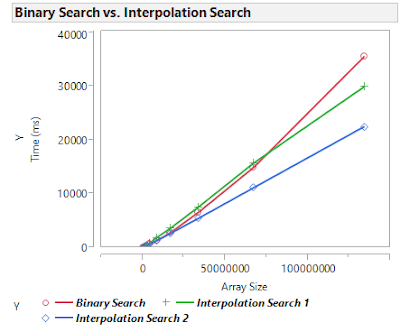
If you have taken an introductory computer science course, you've probably seen the binary search algorithm - an algorithm to efficiently find the index of an item in a sorted array, if it exists. You might not have heard of interpolation search, however. Interpolation search is an alternative to binary search that utilizes information about the underlying distribution of data to be searched. By using this additional information, interpolation search can be as fast as $O(log(log(n)))$, where $n$ is the size of the array. In this post I am going to talk about two implementations of interpolation search. First, I will discuss the algorithm as described on Wikepedia, then I will describe my own version of the algorithm that has a better worst case time complexity than the first and performs better in practice than the traditional binary search and interpolation search algorithms. The Basic Idea Interpolation search models how humans search a dictionary better than a binary search, ...

An Efficient Communication Scheme

Image
In this blog post, I'll be talking about an efficient communication scheme that can be leveraged in parallel programs for broadcast or reduce operations.  The idea is very simple, but I thought it was pretty cool when I learned it, so I thought I would pass along the information to you.  Let's abstract away the parallel programming aspect and analyze the following question: You have a message that you want to share with a large group of people, but you can only share the message with one person at a time. How should you distribute this message? Setting up the Problem To clear up some possible ambiguities, I want to emphasize that it takes one time step to share a message regardless of who you share it with, and anybody can share the message with anybody else (granted they've received it first).  I will identify each person in the group by a unique integer in ${0,1,...,n}$, and I will assign myself the id $0$. This is similar to how we might structure a distributed pr...

Generating Random Numbers from Arbitrary Distributions

Image
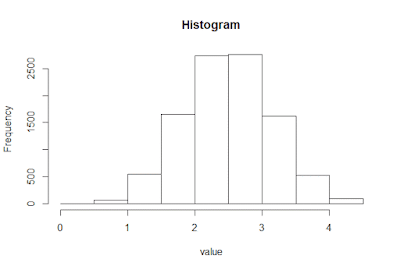
Generating random numbers is an important aspect of programming, and just about every programming language offers some source of (pseudo) randomness, usually in the form of a uniform distribution. For example, java has a builtin function, <code class="java">Math.random()</code> that returns a random floating point number in the range $[0,1)$. In some instances, we would like to have random numbers coming from a different distribution, but most programming languages don't offer this functionality (except very specialized languages such as R). In the rest of this blog post, I am going to explain how you can use a uniformly distributed random number to generate a number from some other distribution. Special Case: The Normal Distribution If you would like to get numbers from a binomial distribution, or are willing to accept an approximation for the normal distribution in favor of simplicity, then you may want to use this technique. If you add together some num...

Triangles Containing the Origin

Image
You may have found this site by searching for information regarding Project Euler Problem 184. This is not a solution to that problem. In fact, it really bothers me when I find people who post their solutions to these problems online, especially the higher level ones. In this blog post, I talk about a simple problem from probability that was motivated from this Project Euler problem, but the solution to this problem is not likely to help you solve that one. Pick three points uniformly at random along the circumference of a unit circle centered at the origin. What is the probability that the triangle connecting these three points contains the origin? Like I said, this problem is not as difficult as the problems that I usually write about, but I decided to write a blog post about it for two main reasons: I wanted to create the animation/simulation for this problem I eventually want to extend this problem to explore all convex polygons instead of just triangles (which is a more diff...

Top Ten Reasons I Like Haskell

A few weeks ago I wrote about some of the differences between functional languages (like Haskell) and imperative languages (like C or Java). While I made some good points in this post, I don't think I gave enough credit to Haskell. After learning more about Haskell, it has become my favorite programming language. In this blog post, I will talk about some of reasons I like Haskell. Please keep in mind that I am relatively new to Haskell and the contents of this blog post are about my experience as a beginner. That being said, the intended audience of this blog post is people coming from an OOP background that are looking for something better. Purity In a Purely Functional language like Haskell, it's impossible to mutate objects in memory. While this may seem like a limitation, I assure you it is not. In Haskell, functions must take input and return output, but they may not have side effects. This has great benefits as it makes it easier to reason about code, and the compiler...

Multi-Core Programming with Java

Processors speeds are no longer growing at the rate we've grown accustomed to. Moore's law states that computers double in speed every 18 months. Moore's law is still alive and well, but we just need to find alternate ways to speed up computers. That's where multi-core programming comes into play. The idea behind it is that 2 heads are better than one and in the right situation 2 processors can work on the same problem to solve it twice as fast. Parallel programming is becoming increasingly important these days and there are many different flavors of it including distributed computing, shared memory computing, and GPU computing. Today I am going to focus on shared memory computing, or using multi-core computers rather than many single core computers. This blog post is intended to serve as a beginners guide to parallel programming with Java. It is recommended that the reader have some java experience and is familiar with some of the features of Java 8 (namely lambda expr...