Posts

Showing posts with the label markov chains

Markov Chains and Expected Value

A few weeks ago, I was using a Markov Chain as a model for a Project Euler problem, and I learned about how to use the transition matrix to find the expected number of steps to reach a certain state. In this post, I will derive the linear system that will help answer that question, and will work out specific an example using a 1-dimensional random walk as the model. Terminology Before I begin the derivation, let me define some terms. The transition matrix is an \( n \) by \( n \) matrix that describes how you can move from one state to the next. The rows of the transition matrix must always sum to 1. States can either be transient or absorbing . An absorbing state is one that cannot be left once reached (it transitions to itself with probability 1). A transient state is a state that is not an absorbing state. In many problems, it is of general interest to compute the expected number of steps to reach an absorbing state (from some start state). Derivation  Let \...
Markov Chains and Baseball

Image
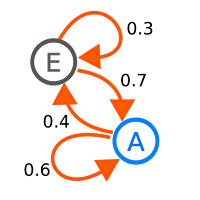
In this blog post, I will give some general background info about Markov Chains, a mathematical structure that arises in Probability theory. I was first introduced to Markov Chains last year and I found them extremely interesting. I found them particularly interesting because they combine ideas from linear algebra, graph theory, and probability theory. Markov chains have applications in many real world situations, including sabermetrics and stock market analysis. A Markov Chain can be thought of as a special type of graph or a non-deterministic finite automaton. Basically, that means that there are a set of states, and you can transition from a set of different states from any given state. The transitions are weighted by probability measures. There are lot's of interesting question you can ask about Markov chains - my favorite is the random walk type problems. Markov chains can be used to model a variety of real world situations, including baseball simulations, stock market behav...